
Brief biographical notes
on Yaroslav Tagamlitzki
Childhood and youth
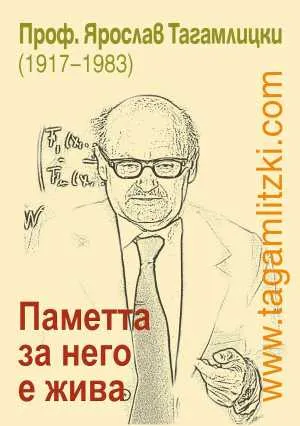
Yaroslav-Roman Alexandrov Tagamlitzki was born on 11 September 1917 in the town of Armavir, Russia. His family moved to Bulgaria in 1921. In 1936 he completed his secondary education at the Second Boys’ High School in Sofia. In the same year he enrolled to study mathematics at what was then the Faculty of Physics and Mathematics of Sofia University. In 1940 he graduated and was seconded by the Ministry of Public Education to do research at the Mathematical Institute of Sofia University, which existed at that time.
In 1942 and 1943 Tagamlitzki specialised at the University of Leipzig under the well-known professors Koebe and van der Waerden. His specialisation ended with the defence of a doctoral thesis. After returning, he did his military service.
Scholar and teacher
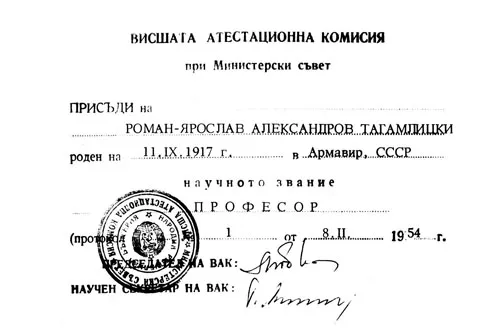
In 1945 Yaroslav Tagamlitzki was appointed assistant at the Chair of Differential and Integral Calculus of Sofia University, which was then headed by the eminent Bulgarian mathematician Professor Kiril Popov (an academician from 1947). In 1947 he was elected Privatdozent and in 1949 regular associate professor (docent) at the same chair. From 1954 Tagamlitzki was professor and head of the Chair of Differential and Integral Calculus. In 1958 he was awarded a second doctoral degree, this time under the new Bulgarian rules governing academic degrees. In 1961 he was elected corresponding member of the Bulgarian Academy of Sciences.
Together with the Chair of Differential and Integral Calculus he headed the Section of Functional Analysis at the Mathematical Institute of the Bulgarian Academy of Sciences and, after the two units were merged at the end of 1970, the Sector of Real and Functional Analysis that resulted from the merger, at the Unified Centre for Mathematics and Mechanics.
For his research on Dirichlet series and on the Laplace integral equation Tagamlitzki received in 1947 the science prize of the Committee for Science, Art and Culture. In 1952 he was awarded the Dimitrov Prize for the work “Investigations on the Abel interpolation series”. For his scientific and teaching work he was decorated with the Order of Cyril and Methodius, First Class, in 1953 and 1967, and with the jubilee medal “25 Years of People’s Rule” in 1969. In 1982 he was awarded the title “Honoured Scientist”.
Scientific work
Tagamlitzki published his first three scientific papers while still a student (in 1938 and 1939). They deal with questions of mathematical analysis concerning the mean value theorem and passage to the limit under the Lebesgue integral sign. His next scientific work, the doctoral dissertation defended in Leipzig, is in the theory of analytic functions.
Between 1946 and 1952 Tagamlitzki published a cycle of papers whose scientific contributions are united by explicitly or implicitly expressed ideas about the role of the notion of indecomposability in mathematical analysis (one of these papers is the work awarded the Dimitrov Prize, mentioned above; the second doctoral degree conferred in 1958 is also connected with the results of that work). Tagamlitzki’s first general theorems concerning this notion were proved in three of his papers, which appeared in 1949, 1952 and 1954 respectively. These theorems belong to functional analysis.
The results contained in the last two of these papers form the basis of an inductive method, developed by Tagamlitzki, for proving properties of various mathematical objects. Tagamlitzki and his students and collaborators gave numerous applications of this method to questions of classical mathematical analysis. This intensive and fruitful work centred on the research circle led by Prof. Tagamlitzki at the Chair of Differential and Integral Calculus. In this circle many of the mathematicians who are today active in research and teaching were formed as scientists.
In 1963 Tagamlitzki achieved a very broad generalisation of the theorems on which the inductive method is based. The well-known Krein–Milman theorem turns out to be a very special case of the general theorem he proved, called the “theorem of topological induction”. Before that, Tagamlitzki had also given a broad generalisation of an important theorem on the separation of convex sets, as well as of Tychonoff’s fundamental theorem on the compactness of topological products. He gave applications of the theorem of topological induction to various questions that had not yielded to treatment by the previously known theorems. After 1970 Tagamlitzki also developed new approaches to the theory of manifolds and to some mathematical questions of theoretical physics.
Lectures and special courses
From the beginning of his academic career until his last days Tagamlitzki took a most active part in the teaching of students. About 60 years ago he developed the first modern course in differential and integral calculus in Bulgaria and taught it until the end of his life, constantly improving and refining it. His textbook on differential and integral calculus, which appeared in six editions between 1954 and 1978, stands out for its high quality not only in our own but also in the world’s textbook literature.
He delivered his lectures with remarkable pedagogical mastery and took enormous care to ensure that the material taught was thoroughly learned. Over several decades he also gave special courses in various other areas of mathematics, such as the theory of real functions, integral equations, combinatorial topology, Fourier series and generalised functions. A particularly important place in Tagamlitzki’s teaching is held by his lectures on functional analysis, which he gave for more than a quarter of a century and which are closely connected with his own research.
On mathematics in secondary school
Throughout his teaching career at Sofia University he kept in touch with secondary schools as well. He repeatedly lectured to school pupils on suitable mathematical topics. He developed a new method of teaching the foundations of mathematical analysis in secondary school and for one school year personally took part in the experimental application of this method in a Sofia school. He also took part in some of the spring conferences of the Union of Mathematicians in Bulgaria with lectures on teaching in secondary school and at university.
The personality and the work of Yaroslav Tagamlitzki left a deep and vivid mark on the history of our science and our education, and in the hearts of a wide circle of people of several generations.
Other interests
Besides mathematics, Tagamlitzki carried out systematic studies on questions of archaeology, linguistics and medicine. He also proposed new ideas in the theory of tonalities in music. Unfortunately, Tagamlitzki’s results in these other fields of knowledge are, at least for now, hard to recover, because he apparently left no detailed written account of them.
Sudden death
Announcement by the editorial board of the journal “Obuchenieto po matematika” (Mathematics Education):
On 28 November 1983 the eminent Bulgarian scholar and unique teacher and educator, Corresponding Member Prof. Dr. Yaroslav Alexandrov Tagamlitzki, head of the Sector of Real and Functional Analysis at the Unified Centre for Mathematics and Mechanics, Sofia, passed away suddenly.
A life devoted entirely to science, teaching and moral self-improvement has come to an end. Prof. Tagamlitzki’s exceptional mathematical and general cultural erudition and his constant high demands, above all on himself, secured him scientific achievements of the highest value. His great responsiveness and his inimitable ability to create a natural contact between himself and his audience won him the respect and love of all who had the good fortune to be his students or colleagues. Until his last day he enjoyed the undisguised affection of the students, who so touchingly accompanied him on his last journey as well.
The Bulgarian mathematical community has lost one of its most brilliant representatives, who educated many generations of teachers and researchers. Prof. Tagamlitzki never ceased to take an active interest in, and to care deeply about, solving the problems of mathematics education in secondary school.
WE BOW BEFORE HIS BRIGHT MEMORY
The funeral*
“... Along the long way to the remote alley where the freshly dug grave was waiting (they say there was no room, and they barely managed to obtain his mother’s plot), a huge procession stretched out.
I did not see anyone step aside to go home into the warmth, as usually happens. It was clear that people had gathered of their own free will to see him off, not under compulsion. And everyone carried flowers, withered autumn ones though they were; nobody had come empty-handed. That does not happen by a script either. Especially in the hands of the young people, those poor drooping bunches were more expressive than the 20 (I counted them) official wreaths with mourning ribbons.
One boy asked his neighbour: ‘What is angina pectoris?’ The other tried to explain: ‘Something with the heart, probably from overwork...’ Everyone knew that on the 28th he had felt unwell in front of the dentist’s surgery in the building of the Academy of Sciences; there were many people in the waiting room, he went into the next room, and there it happened. The dentist tried to give him first aid, but it was too late. They waited four hours for an ambulance to take him away; that day there were many cases of heart attacks. The atmospheric pressure had dropped sharply all of a sudden. It was pouring with rain.
Boyan [Penkov] recalls: ‘In 1946, when I had just become a student of mathematics, Prof. Kiril Popov fell ill and was absent for a whole semester. ... The lectures were taken over by Tagamlitzki, quite young then, he must have been 28 or 29, but in appearance he remained the same to this day, as he lies in the coffin: hunched, slightly stooped, small. At the lectern he was transformed, he simply seized the souls of the students, above all of the first-year students. ... For more than 30 years Tagamlitzki held sway over the coming generations; all of them passed through his influence. He was the first in our country to create a school of mathematicians, he introduced special courses, surrounded himself with young, capable people, renewed the very method of teaching, created science...’”
Funeral oration**
by Prof. Dimiter Skordev (then associate professor and head of the Sector of Mathematical Logic at the Unified Centre for Mathematics and Mechanics)
Bereaved relatives of the deceased, and colleagues!
We are about to take leave of a great man, one of those people whose value and irreplaceability we come to feel fully only when we lose them. Absorbed in the urgent tasks that face us every day, we had grown used to taking the work of Prof. Yaroslav Tagamlitzki as something ordinary — a work exceptional in its depth, importance, versatility and perfection. We accepted what he did as something that could not be otherwise, just as we accept the light of the sun or our parents’ love for us while we still have them in this world. In our minds the Faculty, the Institute and Bulgarian mathematics were inseparably linked with the name of Tagamlitzki, and we could hardly imagine how different things might look without him. But a terrible moment has come, and we stand before the dreadful truth, shaken by the immense and irretrievable loss. We feel immeasurably poorer, deprived of one of the great moral supports of our lives.
With the death of Prof. Tagamlitzki Bulgarian mathematical science has lost one of its most eminent and brilliant representatives, of whom it can be proud and to whom it owes no small part of its progress over the last four decades. Prof. Tagamlitzki contributed a very great deal to the development of our mathematics, both through his remarkable scientific achievements and through training a whole generation of younger mathematicians and introducing them to research. Prof. Tagamlitzki’s main scientific merits lay in classical and functional analysis. I would like to note, however, that other areas of mathematics, at first sight far from Tagamlitzki’s main scientific interests, were also the object of his attention and felt his beneficial influence. One such area is mathematical logic. Probably few people know that as early as one of the first post-war years the assistant Tagamlitzki gave a talk on it to the mathematical community. Moreover, Prof. Tagamlitzki’s marked attention to the logical side of the material he taught undoubtedly created favourable ground for some of the students who attended his lectures and used his splendid textbooks to turn to questions of mathematical logic.
Undoubtedly the scientific work of Prof. Yaroslav Tagamlitzki is a precious national treasure of ours and an important asset of contemporary mathematics in the world, but his work as a teacher is of no less importance. Death has torn from our ranks a man who regarded teaching as his most important task before society and the people. Prof. Tagamlitzki spared neither effort nor time to fulfil this task as effectively as possible. His dedication was truly boundless. Thanks to it, thousands of students received not only a solid mathematical training but also a wonderful example of a serious and thorough attitude to work. Until the last days of his life, despite some alarming signs that all was not well with his health, Prof. Tagamlitzki carried an exceptionally heavy teaching load. Even those of us who knew something of his health troubles did not suspect how serious the danger was, because he was, as always, overflowing with energy, his brilliant mind showed in everything the remarkable penetrating power we knew so well, and his scientific pursuits and interests were as varied as before.
The sudden death of Prof. Yaroslav Tagamlitzki is a cruel surprise for us all, an utterly untimely interruption of his vigorous activity for the benefit of society. The blow is especially heavy for those of you who had the good fortune to be students of Prof. Tagamlitzki and were formed as teachers and researchers under the enormous influence of his striking individuality. He was a spiritual father and a wise mentor to all these people. Even those of them who, like me, later turned to research in other branches of mathematics could count on his unfailing interest in their work, on his sensible and competent advice and on his boundless goodwill. Alas, now that Prof. Tagamlitzki is no longer among the living, I see that he too probably needed more attention and interest on our part towards his scientific research. Many are his valuable ideas and results which he mentioned to one or another of us but which we do not know in detail. Surely there are also many achievements of his of which we never learned at all and never will, because of his unexpected death and because he published little. Clearly, concerted and persistent efforts will be needed so that as many of his scientific results as possible can be traced and made available to the mathematical community.
At this sad moment, when we bid farewell for ever to the great scholar, teacher and man Yaroslav Tagamlitzki, we must think about how best to honour his memory. Many things could be proposed, but two of them I consider the most important. The first is to continue Tagamlitzki’s scientific work. This, of course, is within the power of only relatively few people — his immediate followers in science. The second of these two things, however, is within the power of all of us. It is to strive always to act as honestly, selflessly and devotedly as the example of his life teaches us.
A deep bow before the bright memory of our unforgettable teacher and colleague Prof. Dr. Yaroslav Tagamlitzki!
* From “The Funeral”, in Blaga Dimitrova, “Otsam i otvad” (On This Side and Beyond). KOTAR’88, Sofia, 1992 (pp. 311–319).
** The funeral oration is taken from the journal “Obuchenieto po matematika”, Sofia, 1983.